

Last time, in Part 1 of this series, I walked through the four abiotic readings, moisture, EC, temperature, pH, that define a good operating range for soil. Hit all four and you’ve created the conditions biology needs. You have not created the biology, and that’s not a small distinction, it’s the whole subject of this piece.
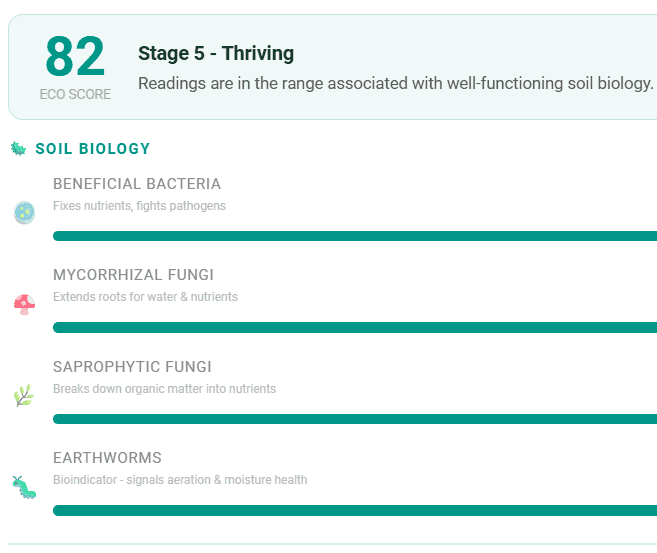
Four more numbers make up the other half of your EII score, and MBS scores these as Soil Biology. Beneficial bacteria, the ones that fix nutrients and fight off pathogens, read at 73% on our Riverbend reference deployment. Mycorrhizal fungi, which extend a plant’s root reach for water and nutrients, 93%. Saprophytic fungi, which break down organic matter into something the plant can actually use, 94%. And earthworms, which we treat as a signal rather than a driver, 80%.
None of those four get measured the direct way EC or pH does. You can’t stick a cheap probe in the ground and read out “mycorrhizal fungi: 93%” the way you’d read a salt concentration. They’re modelled instead, built from the abiotic conditions, historical trends, and known biological patterns, then presented as a confidence score. Worth knowing that up front, because a modelled number and a directly measured one don’t carry quite the same certainty, and I’d rather tell you that than let you assume otherwise.
So why doesn’t a good abiotic reading get you there automatically? Because each of these four populations has its own chain of requirements, and none of them switch on just because pH and moisture happened to read right this morning.
Beneficial bacteria need organic carbon to actually feed on. Good pH alone doesn’t summon them, they need a food source and, for a lot of species, an existing microbial community to grow from. A freshly prepared growing medium with perfect EC and pH but zero organic matter and no prior inoculation will read favourable on all four Part 1 numbers and still have next to no bacterial activity in it.
Mycorrhizal fungi build their relationship with plant roots over a whole growing season, not a single reading cycle. The network physically has to establish itself, hyphae actually colonising the roots, and that takes time, often prior exposure or deliberate inoculation. A field that was recently tilled or is new to cultivation can show perfect temperature and moisture and still have no mycorrhizal network at all.
Saprophytic fungi break down dead organic matter. No organic matter means no saprophytic activity, full stop, doesn’t matter how correct your moisture reading is. You could hold textbook-perfect moisture and temperature over bare, depleted soil forever and never build a decomposer population, because there’s simply nothing there for them to break down.
And earthworms, our data model treats those as a signal, not something you drive directly. Their presence tells you aeration and moisture have been good for long enough that a population settled in and stuck around. You can’t move that number by adjusting a sensor setting, it’s downstream of conditions holding steady over real time, not an input you control directly.
Which is also why Riverbend scored 82 when we pulled this reading, down from the 93 you saw in Part 1 and still short of 100, even with every abiotic reading sitting comfortably in the ideal range. Mycorrhizal and saprophytic fungi are sitting high at 93 and 94%, but beneficial bacteria at 73% and earthworms at 80% are pulling the composite down from the theoretical top, and that gap is telling you something real: the soil’s in good shape, rated Stage 5, Thriving, but the bacterial population is still catching up to what the conditions can support.
Here’s the build-vs-buy problem in plain terms. You could hit moisture 27.5%, EC 1.4, pH 6.6, 20°C in a system with zero biology, a hydroponic setup engineered to those exact numbers would do it. It would report a favourable profile on paper and contribute nothing to soil regeneration, because there’s no soil there to regenerate. The biology score exists specifically to catch that gap, so “the numbers look right” and “something is actually alive and working down there” don’t get treated as the same thing.
Next time closes the series with the one variable no sensor, controller, or amendment schedule fully answers to: weather and the outside environment, and what that means for how much control you actually have.
Curious what your own soil’s biology score would look like instead of a reference example? Get a SmartFarm quote and we’ll get real numbers off your ground.

